Literature sharing: อินเทอร์เฟซสมอง-คอมพิวเตอร์-Based Soft Robotic Glove การฟื้นฟูสมรรถภาพ for โรคหลอดเลือดสมอง - โรคหลอดเลือดสมอง Center
Background:Upper limb impairment is common in โรคหลอดเลือดสมอง and can have a devastating impact on the daily lives of โรคหลอดเลือดสมอง survivors. Conventional การฟื้นฟูสมรรถภาพ strategies targeting motor impairments in โรคหลอดเลือดสมอง survivors include the multidisciplinary treatments of กายภาพบำบัด and กิจกรรมบำบัด. Recently, techniques such as constraint-induced movement therapy, การบำบัดด้วยกระจกเงา (MT), and robot-assisted therapy utilise end effector systems. While such approaches have been reported to be efficacious in several studies, they largely require a minimum level of residual movement of the paretic limbs to carry out, and this excludes a large proportion of โรคหลอดเลือดสมอง patients, such as in the case of CIMT. Using อินเทอร์เฟซสมอง-คอมพิวเตอร์ (BCI)-based motor imagery (MI) presents an alternative means of การฟื้นฟูสมรรถภาพ to address the issue faced by patients with negligible residual motor function.
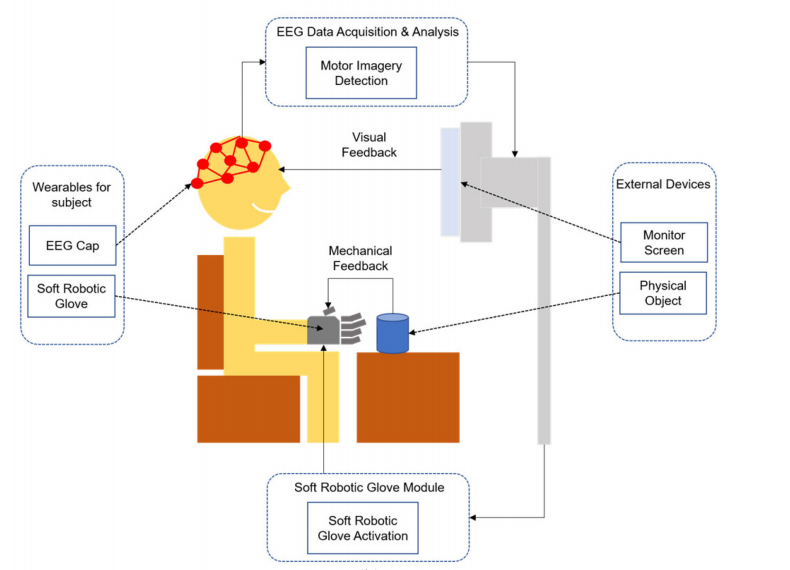
Objective: This randomized controlled feasibility study investigates the ability for clinical application of the อินเทอร์เฟซสมอง-คอมพิวเตอร์-based Soft Robotic Glove (BCI-SRG) incorporating activities of daily living (ADL)-oriented tasks for การฟื้นฟูผู้ป่วยโรคหลอดเลือดสมอง.
Methods: Eleven recruited chronic โรคหลอดเลือดสมอง patients were randomized into the BCI-SRG or Soft Robotic Glove (SRG) group. Each group underwent a 120-minute intervention per session comprising 30-minute standard arm therapy and 90-minute experimental therapy (BCI-SRG or SRG). To perform ADL tasks, the BCI-SRG group used motor imagery-BCI and SRG, while the SRG group used SRG without motor imagery-BCI. Both groups received 18 sessions of intervention over 6 weeks. Fugl-Meyer Motor Assessment (FMA) and Action Research Arm Test (ARAT) scores were measured at baseline (week 0), post-intervention (week 6), and follow-ups (week 12 and 24). In total, 10/11 patients completed the study with 5 in each group and 1 dropped out.
Results: Though there were no significant intergroup differences for FMA and ARAT during 6-week intervention, the improvement of FMA and ARAT seemed to sustain beyond 6-week intervention for BCI-SRG group, as compared with SRG control. Incidentally, all BCI-SRG subjects reported a sense of vivid movement of the โรคหลอดเลือดสมอง-impaired upper limb and 3/5 had this phenomenon persisting beyond intervention while none of SRG did.
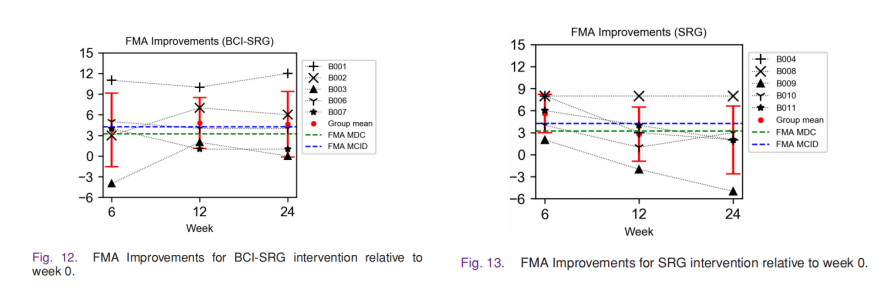
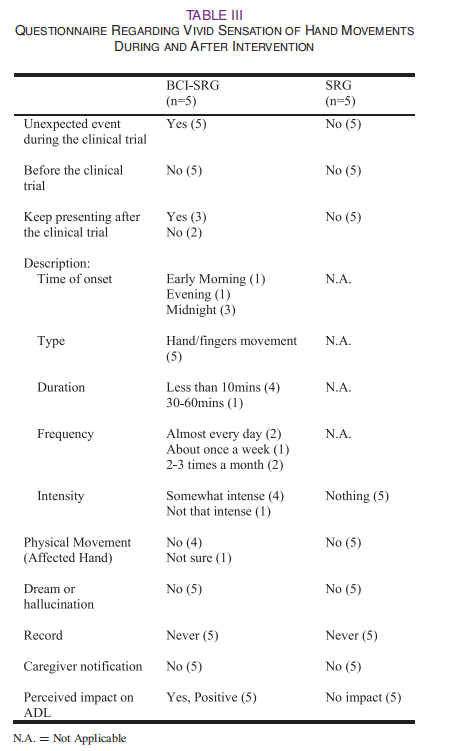
Conclusion: BCI-SRG suggested probable trends of sustained functional improvements with peculiar kinesthetic experience outlasting active intervention in chronic โรคหลอดเลือดสมอง despite the dire need for large-scale investigations to verify statistical significance. Adding BCI to soft robotic training for ADL-oriented การฟื้นฟูผู้ป่วยโรคหลอดเลือดสมอง holds promise for sustained improvements and elicited perception of motor movements.
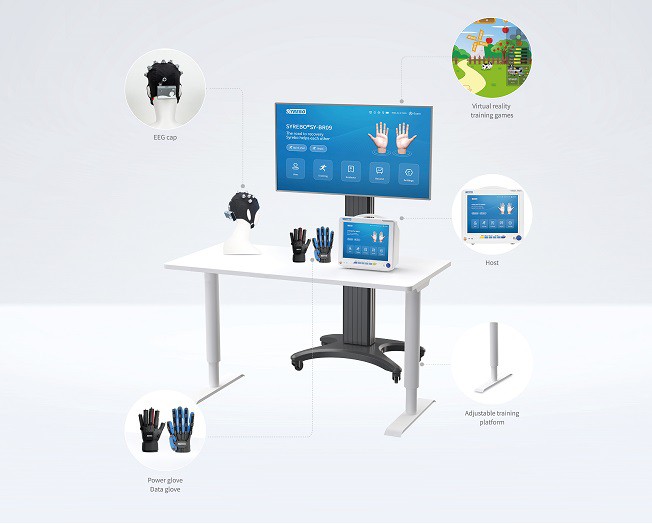
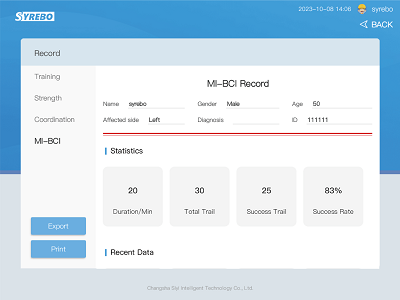
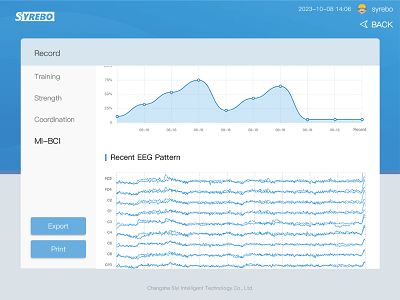
As the innovative อินเทอร์เฟซสมอง-คอมพิวเตอร์-based soft robotic glove (BCI-SRG), the Syrebo hand หุ่นยนต์ฟื้นฟูสมรรถภาพ (BCI) based on the principles of motor imagery and neural plasticity can achieve a "perception-control" bidirectional closed-loop neural stimulation, significantly improving การฟื้นฟูสมรรถภาพ effectiveness. It adopts a brain-inspired algorithm to capture EEG, ensuring data accuracy. At the same time, It can collect EEG signal data and can be viewed on software, providing references for การฟื้นฟูสมรรถภาพ programs and clinical research. Request demo & trial: [email protected]
Reference: Cheng N, Phua KS, Lai HS,et al. อินเทอร์เฟซสมอง-คอมพิวเตอร์-Based Soft Robotic Glove การฟื้นฟูสมรรถภาพ for โรคหลอดเลือดสมอง. IEEE Trans Biomed Eng. 2020 Dec;67(12):3339-3351.